Big feelings: what to do with anger, fear and sadness
A child in a full tantrum cannot be reasoned with, because the reasoning part is offline. What works is the opposite of what feels natural, and there is good evidence behind it.
A two- or three-year-old in a full tantrum cannot be reasoned with, because the part of the brain that does reasoning is offline. What works is the reverse of what feels natural: name the feeling first, solve the problem second.
Putting a feeling into words measurably reduces its intensity — brain imaging shows labeling an emotion dampens the amygdala response. And children who can name what they feel at four do better socially at six. Naming is not soft. It is the skill.
What changes between two and eight
| Age | What the child can do | What they need from you |
|---|---|---|
| 2–3 | Feels everything at full volume. No words for it in the moment. Tantrums peak here and are developmentally normal. | Calm, presence, very few words. Explanations come after, not during. |
| 3–4 | Names happy, sad, angry, scared. Cannot yet hold two feelings at once. | Your labels, out loud, many times a day — for them and for yourself. |
| 4–5 | Recognizes feelings in other people's faces. Starts asking why someone is sad. | Talking about characters in books and drawings — safer than talking about themselves. |
| 5–6 | Can wait, sometimes. Knows a feeling can be hidden from other people. | Strategies they choose themselves, in advance, while calm. |
| 6–8 | Mixed feelings — excited and nervous about the same thing. Strong sense of fairness. | Being taken seriously. At this age, being dismissed does more damage than the original upset. |
Why naming works
In a study by Lieberman and colleagues, people shown emotional faces had a weaker amygdala response when they put a label on the emotion than when they simply looked. Choosing the word does part of the regulating. A later review by Torre and Lieberman gathered the evidence for this as a form of implicit emotion regulation — it works without the person trying to calm down.
In children, the long-term version of the same thing shows up in Denham's work: preschoolers with better emotion knowledge — being able to recognize and name feelings — are rated as more socially competent later, and it predicts early school success independently of language ability.
So "you're really angry that it broke" is not a way of being gentle instead of dealing with it. It is dealing with it.
What to say, and in what order
- Get low and get quiet. Down to their height. A raised voice adds to what they are already managing.
- Name it. "You're angry. You wanted to keep playing." Short. Do not ask them to confirm it.
- Allow the feeling, hold the limit. "You can be angry. I won't let you hit." Both halves, in that order. The feeling is never the thing being refused.
- Wait. This is the part adults skip. A big feeling needs time to pass through, and nothing said during it is heard.
- Afterwards, and only afterwards, solve it. "What could we do next time?" A calm child can plan; an upset one cannot.
Four phrases that make it worse, and the reason: "You're fine" (teaches them not to trust what they feel), "Don't cry" (makes the feeling itself the offence), "It's nothing" (it is not nothing to them), and "Big kids don't do that" (adds shame to an already full load).
The three that come up most
Anger is usually the second feeling. Underneath it is almost always disappointment, tiredness, or a loss of control. Name the one underneath if you can see it: "you were really looking forward to it" lands better than "calm down." Anger also needs somewhere physical to go — pushing against a wall, stamping, squeezing something — which is not the same as hitting.
Fear shrinks when it is made concrete and grows when it is argued with. "There's nothing under the bed" is a debate the child will win. Looking under the bed together, and naming what is there, is not. Fears of the dark, of dogs, of being alone are all age-typical between three and six.
Sadness asks for less than parents think. It does not need fixing or distracting; it needs company. Sitting next to a sad five-year-old without talking is a complete response.
Where a coloring page helps
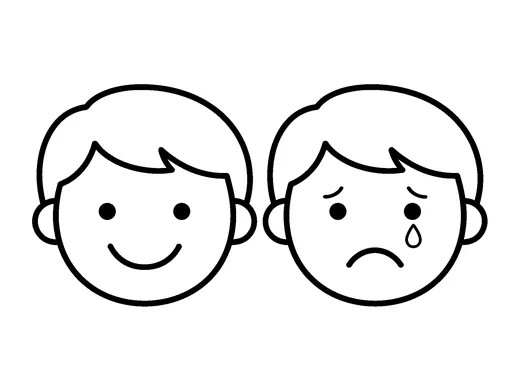
Not during. Nothing helps during. But afterwards, and in the calm times in between, a page is a useful prop for two reasons: the child's hands are busy, which makes talking much easier than face-to-face questioning, and a drawn face is somebody else's feeling, which is far safer to discuss than their own.
- Talk about the character, not the child. "How do you think she's feeling?" then "when do you feel like that?" The second question only works after the first.
- Let them choose the color for the feeling. There is no correct answer, which is the point — and children are often very definite about it.
- Color together in silence after a hard afternoon. Repair does not need a conversation. Sitting down next to them is the message.
- Use the calm moment to make the plan. "Next time you're that angry, what should we try?" A plan made while calm is one they might actually use.
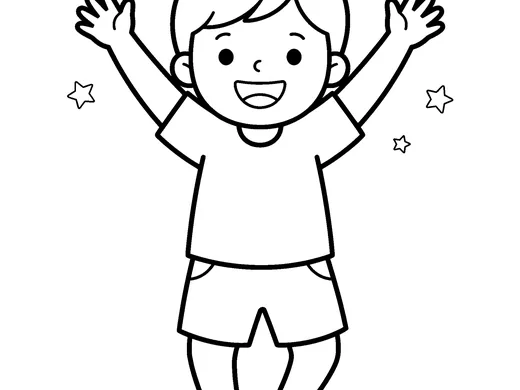
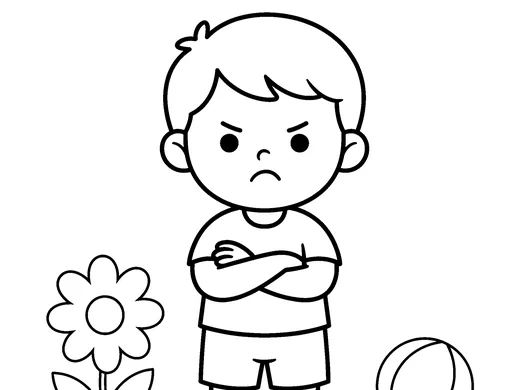
Our feelings pages are drawn for exactly this — one clear face or situation per page, nothing to interpret — and the me and my body pages work the same way for the physical side: tired, hungry, hurt.
When to ask for help
Tantrums peak between two and three and taper off through four. What is worth raising with a pediatrician is a pattern rather than a bad week:
- Tantrums that are still frequent and intense after about five, or that regularly last much longer than 15–20 minutes.
- Outbursts that hurt the child or other people, or that happen at preschool as well as at home.
- A child who cannot be soothed by anyone, including people they trust.
- Fears that stop ordinary life — not going to bed, not leaving the house.
- A flat, withdrawn child, or one whose feelings seem to have gone quiet. Withdrawal gets noticed far later than anger, and matters just as much.
Sources
- Lieberman M. D. et al. (2007): Putting feelings into words — affect labeling disrupts amygdala activity in response to affective stimuli. Psychological Science 18(5), 421–428. PubMed
- Torre J. B., Lieberman M. D. (2018): Putting Feelings Into Words: Affect Labeling as Implicit Emotion Regulation. Emotion Review 10(2), 116–124. sagepub.com
- Denham S. A. et al. (2003): Preschool emotional competence: pathway to social competence? Child Development 74(1), 238–256. PubMed
- Denham S. A. et al. (2015): "I know how you feel" — preschoolers' emotion knowledge contributes to early school success. Journal of Early Childhood Research 13(3). sagepub.com
- CDC, Learn the Signs. Act Early. — social and emotional milestones, 2 to 5 years. cdc.gov
Written by a parent, from published developmental guidance — the sources are listed above. It is general information, not medical advice. If you are worried about your child's development, speak to your pediatrician.
Free starter pack 🎒
10 coloring pages for ages 2–8, plus a guide to what each one builds.
More for parents
The official figure is much smaller than most parents expect, and it only describes half of what is going on. The other half explains why the same child can color for thirty minutes.
6 min readScreensScreen time for ages 2 to 6: the hour, and the things that matter moreTwo health bodies give almost the same number. The number is also the least informative thing they say. Here is what the research actually points at.
7 min readHow to chooseColoring pages by age: why a 3-year-old and a 5-year-old need different pagesMost sites sort coloring pages by subject. That is how adults search and a poor way to choose for a child. Here is what actually changes between ages three and eight.
6 min read