When do children learn colors and shapes?
If your three-year-old confidently calls everything blue, that is the normal middle of the process. Color words work differently from other words, and knowing how changes what you say.
Babies see color from a few months old. Naming it takes years longer: most children can point to a color you name around two and a half to three, and can name colors themselves at three to four. The US milestone checklist puts "names a few colors of items" at four years old.
Shapes run slightly ahead: circle and square by about three, triangle by four, and copying a triangle with a pencil by five. If your three-year-old confidently calls everything blue, that is the normal middle of the process, not a warning sign.
A realistic timeline
| Age | Color | Shape |
|---|---|---|
| 0–1 | Sees and distinguishes colors; full color vision by a few months. | Recognizes faces and outlines; sorts by shape before by color. |
| 18m–2y | Uses color words, mostly wrongly. One favorite word for everything is typical. | Shape sorters; matches a shape to a hole without naming it. |
| 2–3 | Matches like to like: "find another red one." Points to one or two named colors. | Names circle and square. Matches most basic shapes. |
| 3–4 | Names several colors reliably. Mistakes cluster in the hard zone: orange/red, purple/blue, pink/red. | Names triangle; draws a circle when shown how. |
| 4–5 | Names most common colors, including the secondary ones. | Copies a square; names rectangle, oval, star, diamond. |
| 5–6 | Sorts by shade — light blue and dark blue as different things. | Copies a triangle; notices shapes inside other shapes. |
Why color words are unexpectedly hard
Nouns are easy: a cup is a cup, and a child who hears the word twice can use it. Color is not like that. Nothing about an object tells you that its color is the relevant property — a red cup is also plastic, also round, also a cup. The child has to work out that there is a whole dimension called color, separate from what the thing is.
Researchers call this slow mapping: color words are acquired gradually, over months, rather than in the single-exposure way many nouns are. Sandhofer and Smith showed that children first learn the system — that color words go with color words — before any individual word is pinned down, which is exactly why a two-year-old will answer a color question with a color word, and get it wrong. The answer is in the right category. That is the achievement.
It also explains the classic pattern where a child names four colors perfectly and then calls a fifth by the wrong name for another month. Nothing regressed; the fifth word is simply still being mapped.
What actually helps
Two changes make more difference than any flashcard set.
1. Put the color word after the noun, not before. "The ball, it's red" teaches better than "the red ball." In the first version, the color is the new information in its own slot. In the second it is an adjective the child can skip over. This is directly out of the color-word research, and it costs nothing.
2. Compare within the same object. Two identical cups, one red, one blue, is a clearer lesson than a red cup and a blue ball — because the only difference left is the thing you are naming.
Beyond that:
- Sort, don't quiz. "Put all the red ones here" is a task. "What color is this?" is a test, and a child who gets it wrong twice stops answering.
- Name colors while doing something else. Laundry, groceries, crayons on the table. Incidental exposure is what slow mapping needs.
- Do not correct in a way that ends the conversation. "That one's orange — close, they're next to each other" keeps them in it.
- Skip shades until the basics are solid. Turquoise before blue is genuinely confusing.
What coloring adds
A coloring page is one of the few places where a child chooses colors rather than being asked about them, and choosing is the part that sticks. Some things that work well on a page:
- Hand over the crayon by name. "Here's the green one." No question, no answer required, hundreds of repetitions over a year.
- Ask for a plan, not a fact. "What color is the tractor going to be?" A prediction is easier and more fun than a quiz.
- Limit the crayons. Four colors named out loud beats twenty-four in a tin.
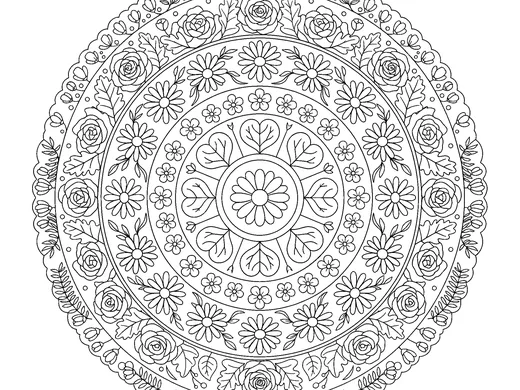
- Use a page with repeated shapes — a mandala or a patterned page — and color the matching shapes the same color. That is shape-matching and color-matching in one task, and older children find it genuinely satisfying.
A purple horse is not a mistake to fix. Realistic color arrives on its own around seven; before that, color choice is decoration.
When to ask
- No color words at all by three and a half, when they are being used around the child.
- Consistent confusion between red and green, or brown and green, that does not shift with age — the pattern for color vision deficiency, which affects roughly one boy in twelve and is worth a check before school, where color coding is everywhere.
- Shape-matching still difficult at four — not naming shapes, but physically matching them.
- Color and shape difficulty alongside general language delay. The combination matters more than either alone.
Sources
- Sandhofer C. M., Smith L. B. (1999): Learning color words involves learning a system of mappings. Developmental Psychology 35(3), 668–679. ucla.edu
- Wagner K. et al.: Slow mapping — color word learning as a gradual inductive process. Cognition. researchgate.net
- Slow mapping in color word acquisition across languages: evidence from Japanese children. Frontiers in Developmental Psychology (2025). frontiersin.org
- CDC, Learn the Signs. Act Early. — 4-year milestone "Names a few colors of items"; 3- and 5-year checklists. cdc.gov
Written by a parent, from published developmental guidance — the sources are listed above. It is general information, not medical advice. If you are worried about your child's development, speak to your pediatrician.
Free starter pack 🎒
10 coloring pages for ages 2–8, plus a guide to what each one builds.
More for parents
Every child's drawing moves through the same sequence, and the ages are far looser than parents expect. Here is what each stage is for, and what not to say about it.
7 min readHow to chooseColoring pages by age: why a 3-year-old and a 5-year-old need different pagesMost sites sort coloring pages by subject. That is how adults search and a poor way to choose for a child. Here is what actually changes between ages three and eight.
6 min readHow long they can sitAttention span by age: how long a child can actually stay with somethingThe official figure is much smaller than most parents expect, and it only describes half of what is going on. The other half explains why the same child can color for thirty minutes.
6 min read